Killer Sudoku game info
Objective
The objective in Killer Sudoku, as in regular sudoku, is to fill the grid with numbers ranging from 1 to 9.
Grid
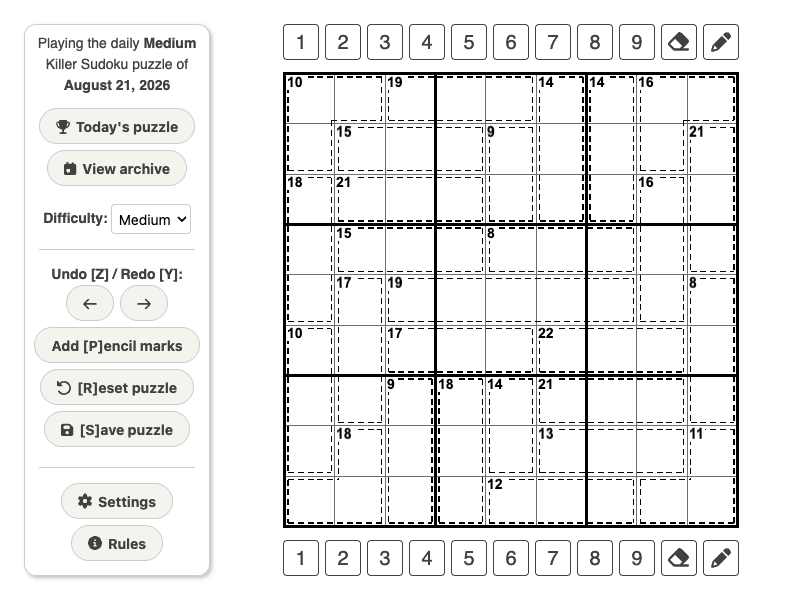
Killer Sudoku starts from the same grid as regular sudoku: a 9x9 grid with 3x3 subsquares. The unique feature of Killer Sudoku is the addition of cages, which are multiple adjacent cells indicated with a dotted line.
Rules
Fill the grid with numbers from 1 to 9 following these rules:
- In each row, column, and 3x3 square, each number should appear exactly once.
- The sum of the numbers in a cage should be equal to the number shown in the top left of the cage.
- Each number appears only once in a cage.
Solving techniques
Below are some solving techniques that can be used to solve Killer Sudoku puzzles.
Technique 1: The rule of 45
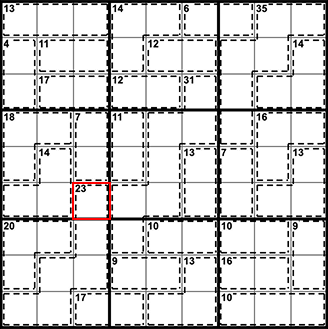
Each row, column and 3x3 square has numbers 1 to 9. Summing them gives 1+2+3+4+5+6+7+8+9=45. This means that each row, column and 3x3 square must sum to 45.
In the 3x3 square of the highlighted cell, we can deduce the sum of the other 8 cells by summing their cage sums (18+14+7=39). This means the highlighted cell must be 45-39=6.
This technique can be generalized to two or more rows / columns / 3x3 squares. E.g. the sum of all numbers in two rows is 2x45=90.
Technique 2: Use pencil marks
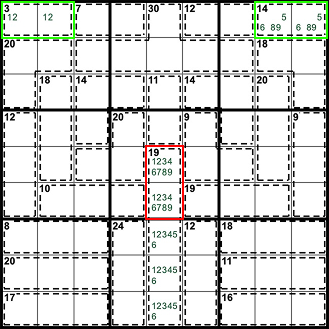
Killer Sudokus are difficult to solve, so using pencil marks is necessary.
Small and large cage sums limit the possible numbers for the cells in that cage, as indicated in green. E.g. a cage with 2 cells that sums to 3 can only be filled with 1 and 2.
The bottom center 3x3 square has cages 24 and 12, meaning 9 (= 45 - 24 - 12) remains for the 3 cells of the 19 cage. This erases 7, 8 and 9 as possible numbers because 6 is the maximum possible (with the other cells being 1 and 2). It also means that the upper two cells of the 19 cage, indicated in red, have to equal 10 (19 - 9), and hence cannot be 5 as numbers cannot repeat in a column.
Technique 3: Naked pairs
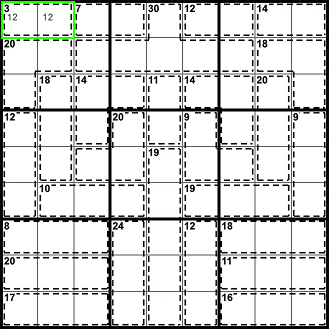
A naked pair is when two cells are restricted to the same two candidates. Since those two digits must fill those two cells (in some order), you can remove them from every other cell in any row, column, or 3x3 square that both cells belong to.
In the example, the top-left cage sums to 3 across 2 cells, so its only possible digits are {1, 2} — a naked pair. Both 1 and 2 can be removed as candidates from every other cell in that row and 3x3 square.
This can be generalized to naked triples, quadruples, ...
Technique 4: Regular sudoku techniques
All solving techniques for a regular sudoku still hold for a Killer Sudoku. So once you have some numbers placed, you can use regular sudoku techniques to solve the Killer Sudoku.
Origin
Killer Sudoku originated in Japan, where it was published under the name "samunamupure," a Japanese contraction of "sum number place." The British daily newspaper The Times introduced the puzzle in 2005 with the name Killer Sudoku, referring to the added difficulty compared to standard sudoku.
Other names for Killer Sudoku include Sumdoku and Addoku.
Similar games
Killer Sudoku is based on the regular Sudoku game. Given the arithmetic that is involved, it is also similar to Kakuro and Mathdoku.
System requirements
Killer Sudoku can be played in all modern browsers, on all device types (desktop, tablet, mobile), and on all operating systems (Windows, macOS, Linux, Android, iOS, ...).
 Solitaire
  Card
Card