Mathdoku game info
Objective
The objective in Mathdoku is to fill the grid with numbers so that every row and column contains each number exactly once, while also satisfying the arithmetic constraints indicated within the outlined regions (called cages).
Grid
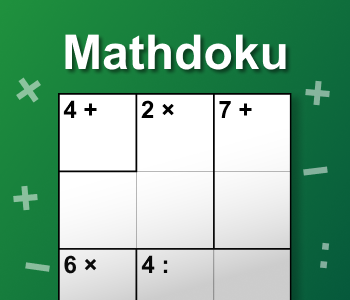
The grid is divided into regions called cages, each marked by a thick outline. In the corner of each cage there is a target number and an arithmetic operation.
Mathdoku grids are always square (for example 5×5, 6×6, or 7×7). The size of the grid determines the range of numbers used. For instance, in a 6×6 puzzle the numbers 1 through 6 are used.
Rules
- The grid must be filled with numbers from 1 to n, where n is the size of the grid.
- Each row and each column must contain every number exactly once.
- Each cage must produce the target number using the indicated arithmetic operation (addition, subtraction, multiplication, or division).
- Numbers within a cage can appear in any order, but the operation must result in the target number.
- For cages with subtraction or division, the operation applies to the numbers in the cage in some order that produces the target result.
Tips
Here are effective strategies for solving Mathdoku puzzles:
- Use pencil marks, which indicate all remaining possible values for a cell, as the main method for solving a Mathdoku.
- Fill in obvious cells immediately, but note they are rare. Occasionally cells can be filled right away (e.g. a single-cell region, or a 3-cell triangle multiplication cage with target 25).
- Use the arithmetic clues in each cage to eliminate impossible values. For example, if a 2-cell cage must sum to 9, the cells can only be 3+6 or 4+5.
- Look at cages with a limited number of valid combinations first. For instance, a 2-cell cage with target 10 using addition only allows 4+6, while a multiplication cage targeting 5 only allows 1×5.
- Use the naked pairs technique known from Sudoku. If a row has a 2-cell region where both cells share the same two possible values, these values can be removed from other cells in the row.
- Remove filled in numbers from the pencil marks of the corresponding row and column. Also, consider the impact within its cage: if a 2-cell cage sums to 9, and one cell has possible values 3,4,5,6 while the other has 3,4,6, then 4 can be removed from the first cell because there is no corresponding 5 left in the second cell.
Origin
Mathdoku is a logic puzzle based on arithmetic constraints. The trademarked names for these puzzles are KenKen and KenDoku. The concept of Mathdoku puzzles was invented by Japanese math teached Tetsuya Miyamoto, who designed them for educational purposes. Other names for Mathdoku puzzles are Calcudoku, Inky, Square Wisdon, CanCan, MinuPlu, and Yukendo.
Similar games
Other puzzle games that require logical reasoning include Sudoku, Kakuro, and Futoshiki.
System requirements
Mathdoku can be played in all modern browsers, on all device types (desktop, tablet, mobile), and on all operating systems (Windows, macOS, Linux, Android, iOS, ...).
Classification: Home ›
Classic ›
MathdokuRating: 73% (41 votes)
Inventor: Tetsuya Miyamoto
Developer: SolitaireParadise
Technology: HTML5
Wiki's: Wikipedia
 Solitaire
  Card
Card