Suguru game info
Objective
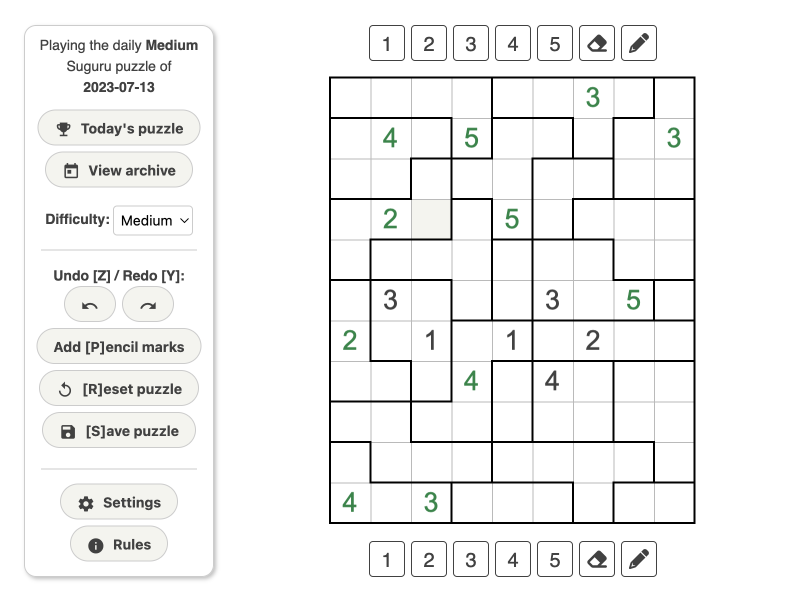
The objective in Suguru is to use logic and deductive reasoning to populate the grid with numbers ranging from 1 to 5 (or 6 in the large puzzles).
Grid
The grid is divided into regions of various sizes, ranging from 1 to 5 (or 6 in the large puzzles). Regions are bordered by a thick line.
Suguru grids can be of arbitrary size, in a rectangular shape. They can be square, but don’t have to be square.
Rules
- The grid has to be filled with numbers ranging from 1 to 5 (or 6 in the large puzzles).
- Each region (indicated by heavy lines) of size n contains the numbers from 1 to n. For example a region of size 3 contains the numbers 1, 2 and 3.
- Cells that are adjacent (whether horizontally, vertically, or diagonally) must not have identical numbers.
Tips
Take these tips into account to help you complete Suguru puzzles quickly and efficiently:
- Start with the regions that have the fewest cells. These can often be filled in easily and quickly.
- Look for cells with limited options: If a cell can only be filled with one specific number, then fill it in immediately. This will help you to narrow down the options for the other cells in the same region.
- Pay attention to the surrounding cells: Since adjacent cells must contain different numbers, you can use the numbers in the cells surrounding an empty cell to narrow down the options for a cell.
- Take breaks: If you find yourself stuck on a particular puzzle, take a break and come back to it later. Sometimes taking a break can help you to see the puzzle from a fresh perspective and make it easier to find the solution.
Step-by-step example
Follow along as we solve a sample Suguru puzzle. Each step includes an image and a detailed explanation of the reasoning.
Step 1
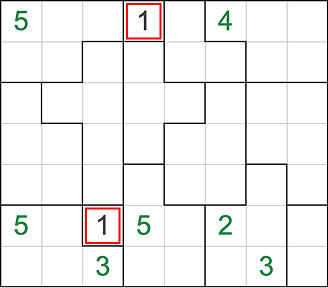
The grid has two regions of size 1, both can immediately be filled with a 1 (shown with a red border in the image).
Step 2
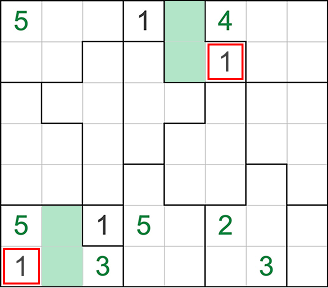
Let's start at the top of the grid. The two cells indicated in green can't contain a 1, since both are adjacent to the 1 placed in the previous step. That leaves only one possible cell for the 1 in the size-3 region, the one outlined in red.
The same logic applies at the bottom left. The two green cells can't contain a 1 due to the 1 placed in the previous step. The region of size five only has one possibility left to place a 1, the one with the red border.
Step 3
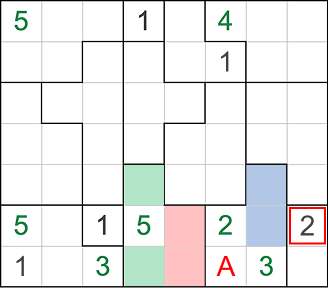
The cell outlined in red can only hold a 1 or a 2, since it's part of a size-2 region. We will see below that if we place a 1 in the cell, this leads to an invalid grid, so the cell must hold a 2.
Suppose the cell outlined in red holds a 1. Then the cells in blue wouldn’t be allowed to contain a 1, meaning that the cell indicated with a red A must contain a 1. But this creates a problem: the size-5 region to the left would have nowhere to place its own 1: the green cells are blocked by the 1 to their left, and the red cells are blocked by the 1 in cell A. Since no valid cell remains, this scenario is impossible, confirming that the red-bordered cell must contain a 2.
Step 4
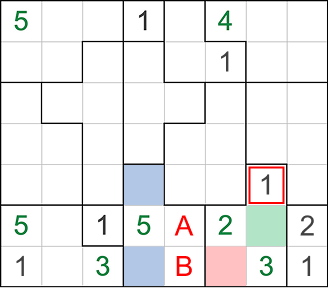
We will now look where a 1 can be placed in the size-5 region in the bottom right.
The green shaded cell can’t hold a 1 because of the adjacent 1 to its bottom right.
The red shaded cell also can’t hold a 1. It’s because the blue shaded cells in the size-5 region to the left can’t contain a 1 because of the adjacent 1, so either cell A or cell B contains a 1. In both cases, if A = 1 or B = 1, the red shaded cell is adjacent to it, so can’t hold a 1.
This means that the only remaining cell in the size-5 region which can hold a 1 is the red bordered cell.
Step 5
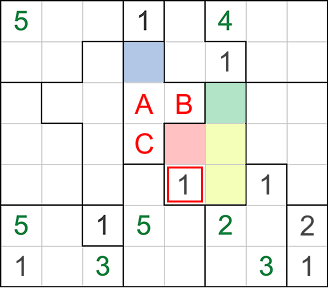
We will continue placing 1's, now in one of the center size-5 regions.
Cell A, B or C must hold a 1, because the blue cell in their size-4 region can't hold a 1 due to the 1 above it. In all cases (A = 1, B = 1 or C = 1) the red shaded cell can't contain a 1.
The green shaded cell and the yellow shaded cells also can't hold a 1 because of their adjacent 1's.
This means the only cell that can hold a 1 in the size-5 region is the red bordered cell.
Step 6
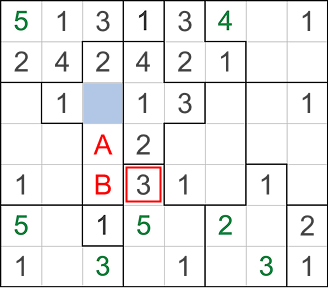
A bit further along in the puzzle, we will now explain the reasoning of placing the 3 in the red indicated cell.
The blue shaded cell in the size-5 region can’t hold a 4 because of the adjacent 4’s, so either A or B must hold a 4.
Looking at the cell with the red border, it has adjacent cells with values 1, 2 and 5. And because A = 4 or B = 4, it also can’t hold a 4. This means the only valid value for this cell is a 3.
Origin
Suguru was originally created in 2001 by Naoki Inaba, a Japanese puzzle maker born in Nagoya, Japan, in 1979. Initially named Nanba Burokku, the puzzle's name was changed to Suguru to better represent the puzzle's content, and that's how this puzzle became known.
Similar games
Other puzzle games that require you to use logic are Sudoku, Kakuro, Mathdoku, and Futoshiki.
System requirements
Suguru can be played in all modern browsers, on all device types (desktop, tablet, mobile), and on all operating systems (Windows, macOS, Linux, Android, iOS, ...).
Classification: Home ›
Classic ›
SuguruRating: 76% (4,667 votes)
Inventor: Naoki Inaba
Developer: SolitaireParadise
Technology: HTML5
 Solitaire
  Card
Card